
Scrupulosity OCD:
A Brief Guide for Clergy
When Pastoral Reassurance Doesn't Bring Peace
A parishioner or congregant may come to you frightened:
What if God hasn't really forgiven me? Was my confession sincere enough?
Could I be going to hell despite genuinely believing in Christ? What if I’m not truly saved?
What if I committed the unpardonable sin or blasphemed the Holy Spirit?
How can I be certain that my motives are right? Am I deceiving myself?
This passage of Scripture frightens me. Can you explain it to me once more?
You listen, offer sound spiritual guidance, and reassure the person. They leave relieved. But soon they return with the same question—or a slightly different version of it. You may be encountering scrupulosity OCD.
Scrupulosity, also called religious or moral OCD, can create a particular challenge for clergy because it often looks like a theological or spiritual problem. But when obsessive-compulsive disorder is driving the questions, providing more theological information or repeated reassurance may bring temporary relief without addressing the underlying problem. In fact, repeated reassurance can inadvertently become part of the OCD cycle.
What May Be Happening
OCD is a brain-based disorder involving the processing of threat and uncertainty. In scrupulosity, the brain's danger alarm is overactive and becomes entangled with the person's faith and moral concerns. Because OCD tends to attach itself to what a person values most deeply, a sincere and devout Christian may become tormented precisely because faith matters so much to them. Faith in Christ is not the source of the disorder; it is something precious which OCD has hijacked.
Intrusive thoughts and doubts can include fears about salvation, forgiveness, sin, blasphemy, confession, prayer, Scripture, moral responsibility, or whether they truly love and believe in God. These thoughts are often ego-dystonic: they conflict with the person's actual beliefs, values, desires and intentions. The distress they cause should not automatically be interpreted as evidence of weak faith or spiritual rebellion.
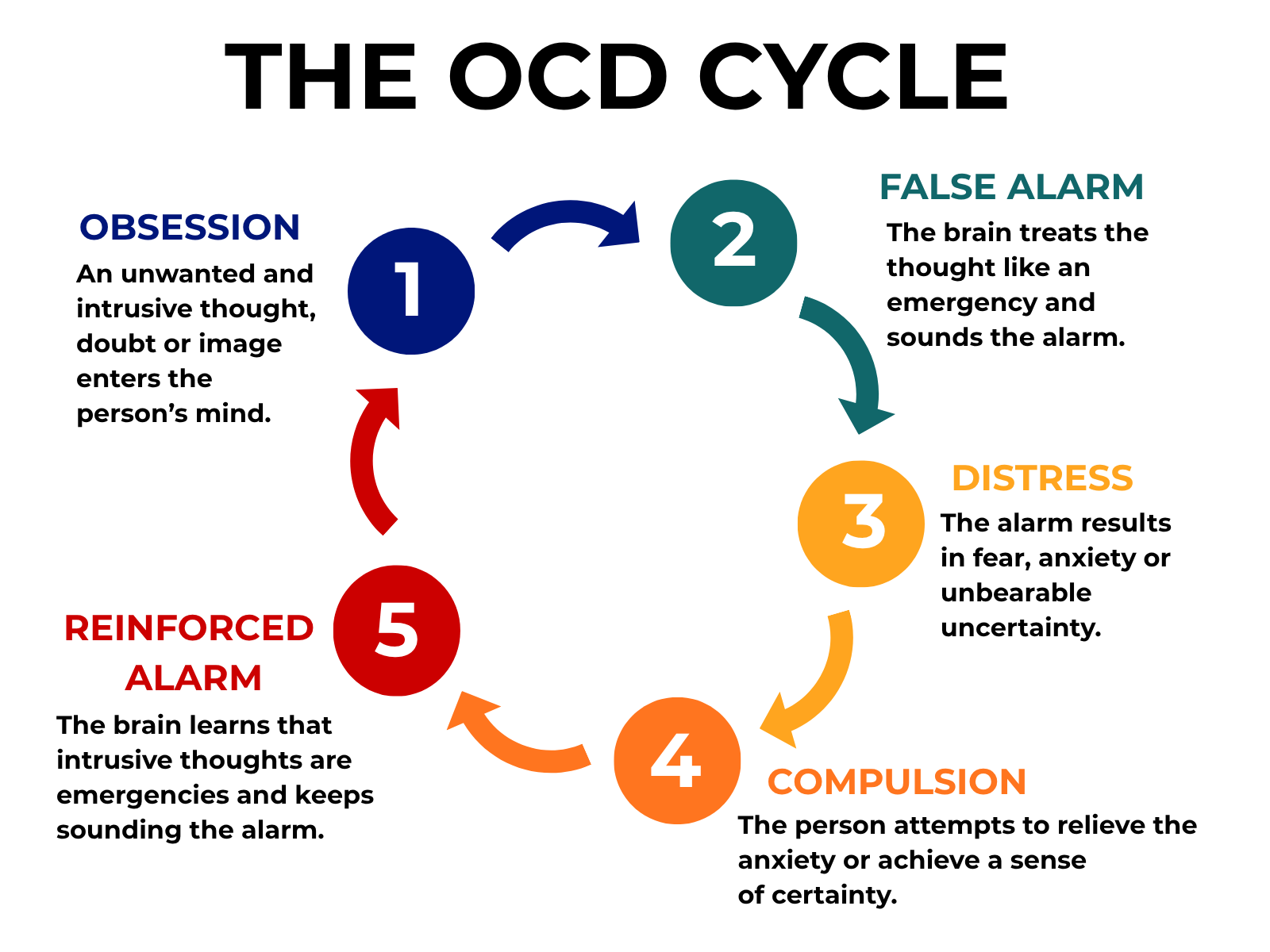
A typical cycle might look like this:
OBSESSION / INTRUSIVE DOUBT
What if God hasn't forgiven me?
↓
ANXIETY AND URGENCY
I have to know for certain.
↓
COMPULSION / SAFETY BEHAVIOR
Confess again. Ask the priest or pastor. Research Scripture. Repeat a prayer. Mentally review what happened. Search for absolute certainty.
↓
TEMPORARY RELIEF
Okay. Maybe I'm safe.
↓
THE BRAIN LEARNS:
That question really was dangerous and doing something about it made me safe.
↓
THE NEXT OBSESSION BECOMES EVEN HARDER TO IGNORE
The Pastoral Dilemma
When a frightened person asks for reassurance, your instinct is compassionate, so you seek to reassure them. It’s important to say that not every person experiencing religious anxiety has OCD. Sometimes a person genuinely needs theological instruction, pastoral counsel, comfort, or clarification. Those things can be enormously helpful for someone experiencing an ordinary theological question or spiritual struggle. But people with OCD may understand Christian teaching quite well and still experience relentless doubt.. They may have read Scripture faithfully, listened to sermons, consulted commentaries, confessed, prayed, and asked trusted spiritual leaders.
THE PROBLEM IS NOT NECESSARILY THAT THEY HAVEN’T FOUND THE RIGHT ANSWER.
THE PROBLEM MAY BE THAT OCD WILL NOT ALLOW THE ANSWER TO FEEL CERTAIN ENOUGH.
Providing the answer again and again can unintentionally teach the person's brain: When this frightening doubt appears, I must have reassurance before I can move on. The temporary relief reinforces the reassurance-seeking, making it more likely that the person will seek reassurance again the next time the false alarm sounds. This does not mean clergy should stop providing spiritual guidance to people with OCD. It means learning to distinguish pastoral care from participation in the obsessive-compulsive cycle. Recognizing the difference can help clergy respond with both theological wisdom and psychological understanding.
What Scrupulosity Can Look Like
Watch for patterns such as:
Asking the same spiritual or moral question repeatedly despite having received an answer
Repeated or excessive confession, including returning to previously confessed concerns
Seeking complete certainty about whether something was sinful, forgiven, sincere, valid, or done correctly
Repeatedly asking whether an unwanted thought reveals something about the person's character or relationship with God
Excessive examination of motives, memories, intentions, or internal states
Repeating prayers until they feel sincere, complete, or “right”
Compulsive Bible study, theological research, sermon watching, or internet searching intended to eliminate anxiety
Moving quickly from one resolved theological fear to another
Experiencing only brief relief after reassurance before doubt returns
The pattern matters more than the particular question.
How Clergy Can Help
1. Take the person's distress seriously without automatically taking the obsession at face value.
You can communicate compassion without confirming that the feared spiritual danger requires immmediate investigation.
2. Notice repeated reassurance-seeking and help remove the sense of emergency.
If you have already answered a question and the person repeatedly returns for greater certainty, consider whether answering it again is actually helping. OCD says: You must resolve this immediately and completely. Often one of the most helpful responses is permission not to settle the question right now.
3. Avoid endless theological analysis of an OCD-generated question.
OCD is extraordinarily good at producing another but what if...? No theological explanation can satisfy a disorder demanding absolute certainty.
4. Establish consistent pastoral boundaries.
When appropriate, clergy and the person's mental health provider can help establish reasonable guidelines around reassurance, confession, spiritual consultation, or other practices that have become compulsive. Boundaries are not rejection. They can be an important form of compassionate care.
5. Encourage OCD-informed mental health support.
Effective help teaches sufferers to recognize the OCD cycle, tolerate uncertainty and distress without performing compulsions, and gradually retrain the brain's response to false alarms. Mental health care does not need to compete with Christian faith. Clergy provide spiritual guidance and care, while an OCD-informed professional addresses the brain-based disorder. The goal is to help the person move toward a relationship with God increasingly characterized by trust rather than fear.
Would You Like to Talk?
I'm Rachel Stanton and I am certified as Master Mental Health Coach and Brain Health Coach through the American Association of Christian Counselors. I work via video conference with Christians struggling with scrupulosity OCD. I help clients understand how OCD works in the brain and teach them practical, evidence-based strategies for responding differently, while also supporting them in their faith. When a person's needs exceed what coaching can address, I encourage and equip them to seek appropriate clinical care.
If you're a member of the clergy and have encountered scrupulosity in your parish or congregation, I offer a free 15-minute consultation to answer questions and help you think through what you may be seeing. If you would like to have a conversation about faith and OCD, please use the scheduler to find a time that works for you. Blessings on you and your ministry!